All ages
Astronomy
What is a black hole, and how did we photograph something that swallows light? What is the invisible matter holding galaxies together, and what came before the stars? Work it out with your tutor, one clue at a time, from black holes and exploding stars to the planets in tonight's sky and the first moments of the universe. Then go deeper: the arguments over how fast the universe is expanding, exploding and ringing stars, how planets are born, the map of our own galaxy, and what the space probes found. No maths or science background needed.
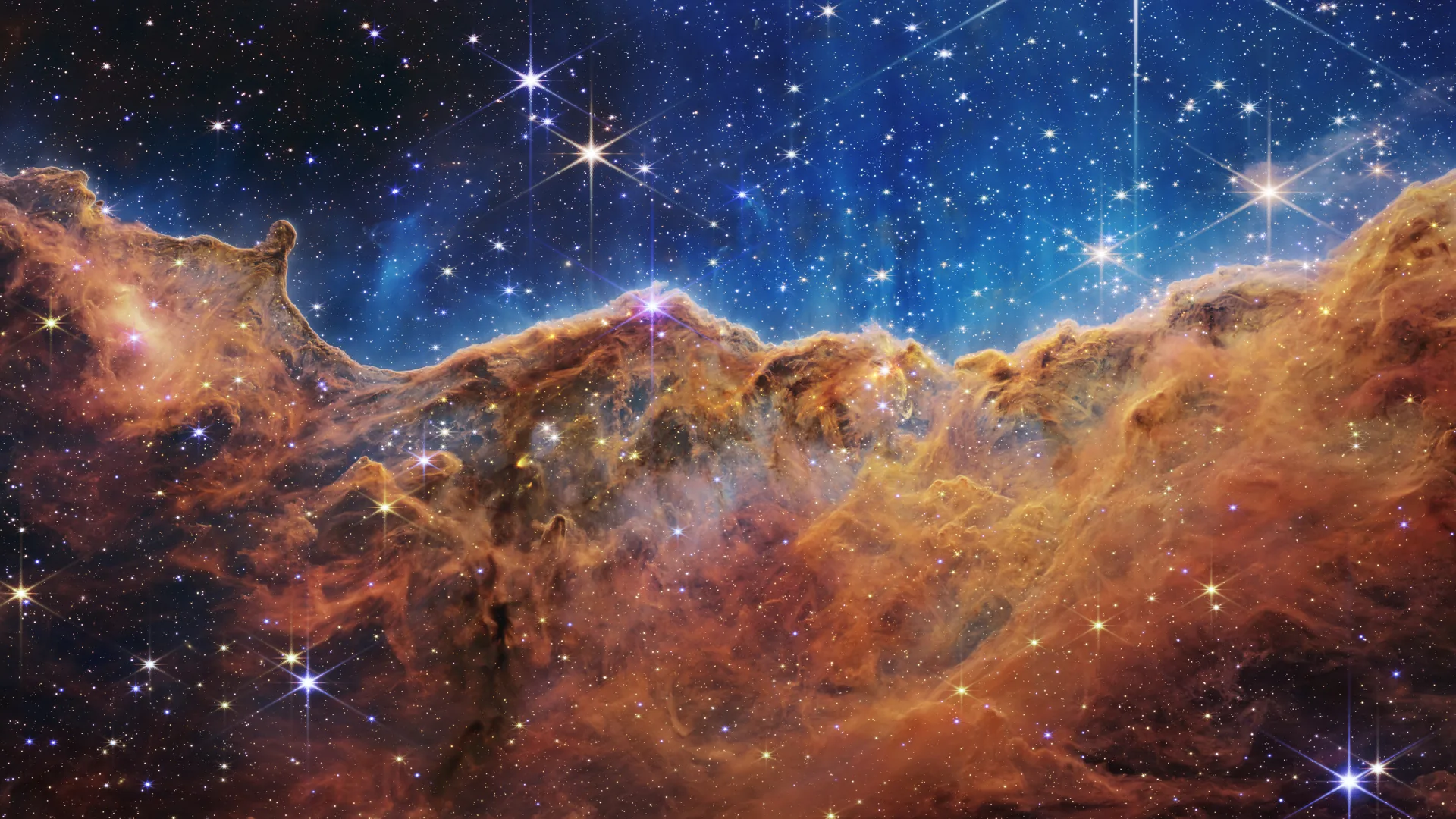
The Cosmic Cliffs, a star-forming region in the Carina Nebula, photographed by the James Webb Space Telescope in 2022.
NASA, ESA, CSA, STScI · Public domain
Science
- Black Holes and the Lives of Stars What makes the Sun shine if it isn't on fire, and how can we tell what a star is made of without ever going there? Trace a star's life from its birth in a cloud of gas to its end, as a quiet white dwarf or in an explosion that leaves a neutron star or a black hole behind. Then go to the edge of a black hole, picture what would happen if you fell in, and find out how colliding neutron stars made much of the gold on Earth.
- Dark Matter, Galaxies and the Big Bang Why is the night sky dark, and how did we discover that the Milky Way is only one of countless galaxies? Find out how we measure distances across the universe, then follow the clues to what most of it is made of: dark matter, which no one has ever seen directly, and dark energy, the unknown something making the universe expand faster and faster. Finally, work your way back to the Big Bang and ask how it will all end.
- Our Sky, the Solar System and Other Worlds Why do we have seasons, and why is Venus hotter than Mercury? Start with the sky above you, from the Moon's phases to eclipses, and see how we worked out, from Ptolemy to Newton, that the Earth goes round the Sun. Then tour the Sun, the planets and their moons, comets and Pluto, and the worlds that circle other stars.
Ready to start learning?
Start for free